LNKLING IMAGE · AI VISUAL KNOWLEDGE
Turn an idea into a controllable image.
An editorial knowledge base for AI image models, prompts, and visual direction. Start with the core formula, then explore scenes, styles, and model tests.
Featured prompt
View full prompt
For each photo I upload, create a separate high-end design poster individually, without multi-image collages—output each photo on its own. Use an overall 3:4 vertical composition, with the top and bottom sections strictly 1:1 in height, each taking up 50% of the frame.
The upper half retains the original photo, preserving the main subject's identity, structure, proportions, realistic texture, natural lighting and shadows, and original color atmosphere. Only apply subtle high-end photographic color grading to give it the quality of art magazines, independent publications, and exhibition photography. To fit the frame, you may naturally extend the sky, ground, or environmental background, but do not stretch, distort, or alter the main subject.
The lower half extracts the most recognizable subject, outline, pose, and narrative relationships from the photo, reconstructing them into a 3D thick-coated oil painting-style micro-landscape illustration poster. Do not mechanically replicate the photo; instead, transform the subject into a delicate, three-dimensional, tangible miniature landscape, reshaped with thick coating brushstrokes, color layering, and sculptural volume. Retain the subject's core identity and key features, while moderately optimizing angles, proportions, and details to better suit a micro-landscape presentation.
The composition uses large areas of negative space + a centered or slightly off-center diagonal main axis. On a bright white textured paper surface, support the subject with a translucent thick-coated color band related to the original photo's theme, which can be transformed into water surfaces, ground, paths, light bands, or abstract landscape slices; the subject interacts naturally with the color band, and add reflections, ripples, light spots, or extending brushstrokes based on the content. The background retains only minimal thick-coated clouds, sun, mist, or nature imagery related to the theme, creating a light and poetic sense of spatial layering.
The painting language emphasizes thick-coated oil painting × miniature entity × translucent light sense. Retain obvious pigment buildup, palette knife marks, undulating edges, paper texture, and semi-handmade modeling feel; focus thick coating on water surfaces, clouds, color bands, and localized highlights, making the subject both delicately three-dimensional and possessing the material quality of real oil paint.
The color palette extracts the brightest, most vibrant, most life-filled colors from the upper photo and remixes them, rather than averaging the colors. Overall, increase brightness and color purity, using clear sky blue, lake green, tender green, warm yellow, coral orange, peach pink, and other lively hues naturally derived from the original image, forming a healing effect through fresh cool-warm relationships. Use ample pure warm white as breathing space, with main colors vivid but not glaring; localized warm orange, golden yellow, or pink can serve as sunlit accents, giving the image a sunny, fresh, warm, lighthearted, and vital color spirit. Avoid grayish dirtiness, faded tones, subdued Morandi-ization, dark brown filters, fluorescent colors, and cheap candy vibes.
Use minimal text intervention: distill a short title from the photo's subject identity, location, mood, or symbolic meaning, paired with very sparse subtitles, numbering, or micro-annotations. Keep text delicate, restrained, and with ample negative space; arrange it cleverly along the diagonal main axis, subject edges, or large blank areas, like refined annotations in art publications.
Overall, present a high-end healing aesthetic formed by bright white background, vibrant thick coating, translucent colors, miniature subject, large areas of negative space, and warm light sense. Whether the subject is architecture, people, animals, plants, objects, vehicles, or natural landscapes, maintain clear identity and vibrant colors, avoiding grayish dirtiness, dullness, cartoon toy vibes, plastic CG feel, e-commerce vibes, and template feel.
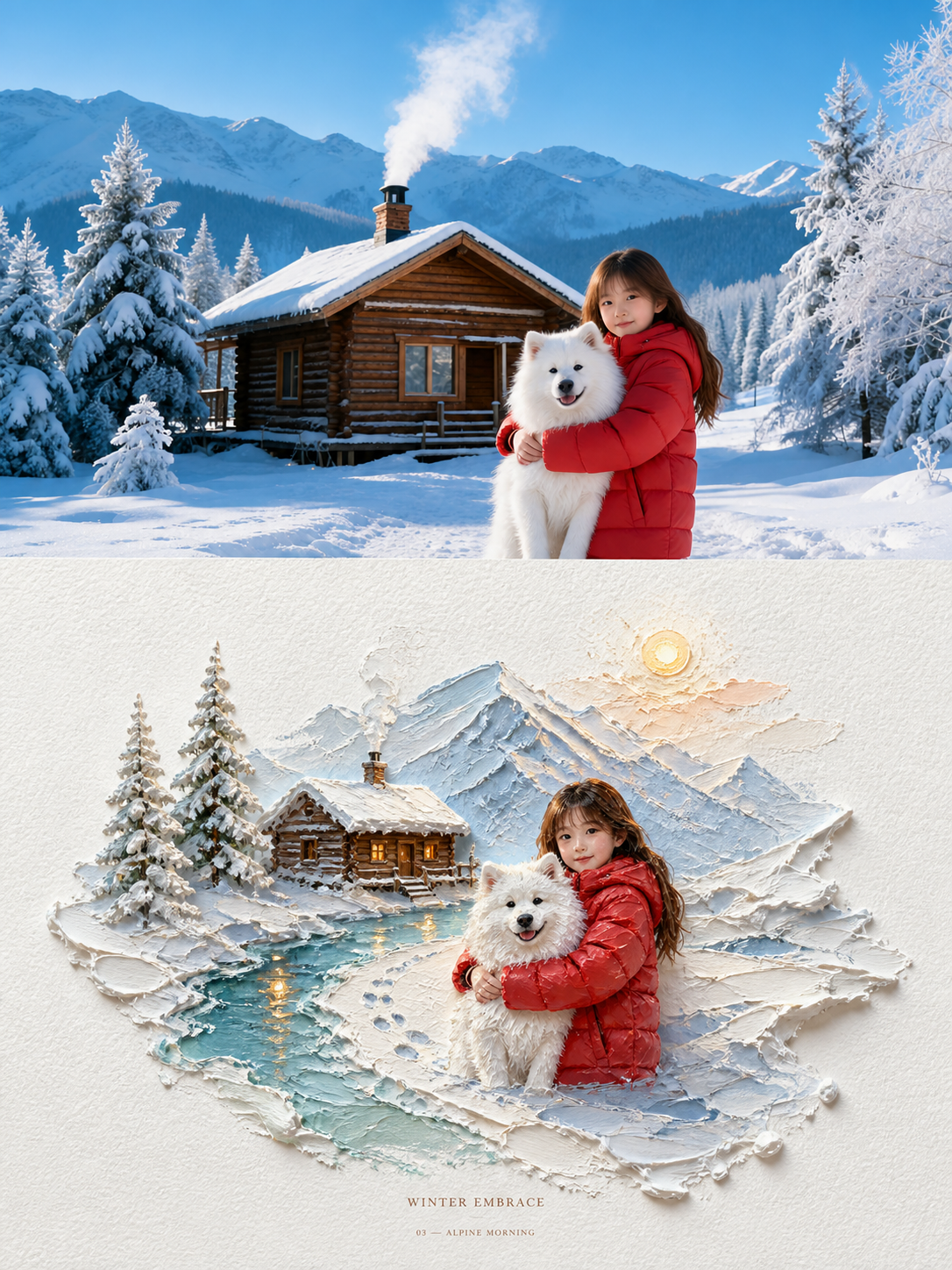
01
Winter Embrace
Snow, cabin, portrait and white dog
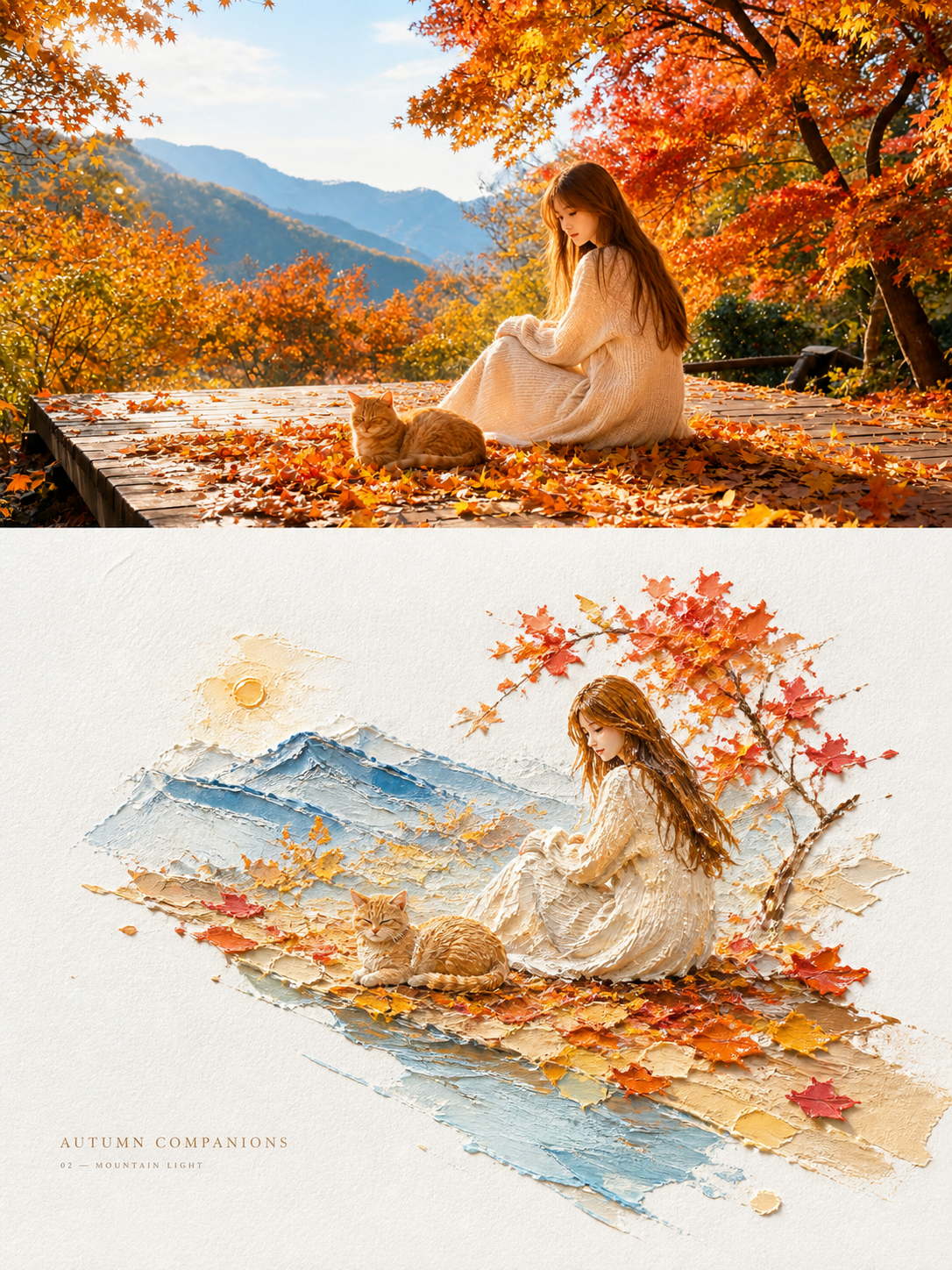
02
Autumn Companions
Mountain light, portrait and ginger cat
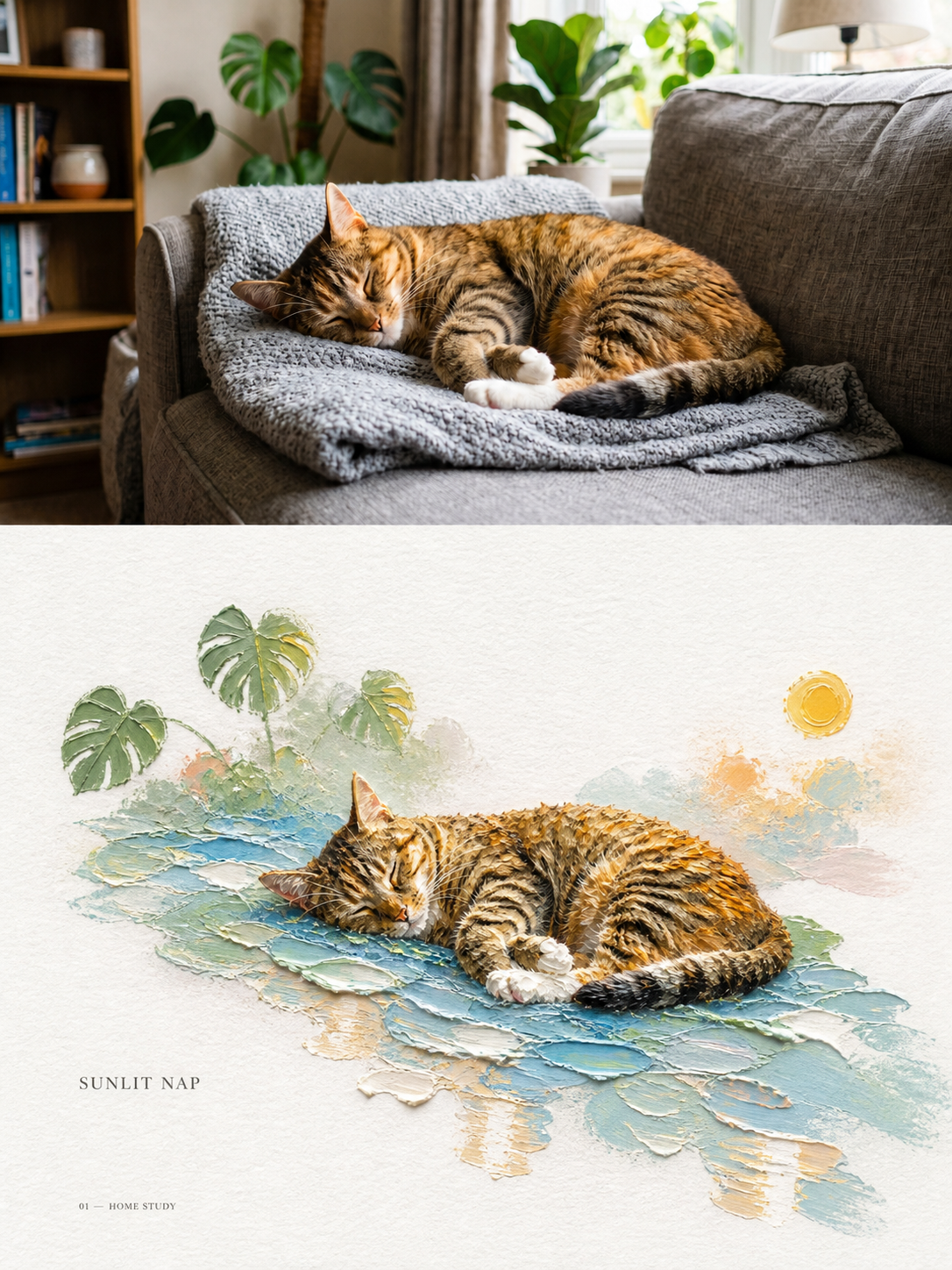
03
Sunlit Nap
Warm interior light and sleeping tabby
View full prompt
Please create each uploaded group photo into a standalone high-end minimalist design poster, using an overall 3:4 vertical long image composition. The image is strictly divided into four horizontal zones from top to bottom (each occupying 25% of the height), with seamless transitions between zones—no dividing lines, no gaps—collectively forming one complete vertical long image.
Overall Sequence (From Top to Bottom)
1. Original Photographic Scene
2. Minimalist Acrylic Illustration Style
3. Minimalist Line Drawing Sketch Style
4. Minimalist Watercolor Wash Style
The four zones maintain compositional logic coherence—character positioning, gaze direction, and scene flow should echo each other, making the entire long image feel like a visual translation progressing layer by layer from reality to abstraction in the same moment, rather than four arbitrarily spliced pictures. Since each zone adopts a horizontal wide aspect ratio, the main subjects in each layer are suggested to be horizontally centered, with ample blank space retained on the left and right to avoid edge adhesion or crowding.
First Layer: Original Photographic Scene
Retain the original group photo's main structure, multi-person real interactions, authentic textures, natural lighting and shadows, and the existing color atmosphere; apply only subtle high-end photographic color grading to present a magazine photography and art exhibition poster quality. Without altering character relationships or compositional logic, naturally extend the ground or environmental background to adapt the image to the horizontal wide zone, enhancing spatial depth and narrative sense.
Second Layer: Minimalist Acrylic Illustration Style
Use thick acrylic paint as the primary medium overall, but the expression must be restrained and simplified, eliminating all non-essential elements and retaining only the core subject structure and visual relationships.
- Background uses off-white, light gray-white, or natural paper texture base color, with subtle, delicate paper fiber grain and slight paint bleed effect.
- Main subjects appropriately scaled down, horizontally centered, with large areas of pure blank space retained on both left and right sides.
- Elements such as characters, trees, buildings, water surfaces, ground, rocks, roads, etc., all adopt highly generalized acrylic color blocks and minimalist outlines, retaining only the most basic shapes and directional relationships.
- Brushstrokes simplified to a minimal number of directional flat washes or single color block covers, avoiding complex structures, texture layering, or decorative strokes.
- Color blocks clearly separated, strictly prohibiting overlaps, layering, or complex interweaving; shapes independent with distinct boundaries.
Third Layer: Minimalist Line Drawing Sketch Style
Use minimalist continuous lines as the primary expressive language, akin to the restrained beauty of high-fashion sketches or architectural line drafts.
- Line thickness uniform or with only subtle variations to emphasize key contours; no hatching, shading, or texture buildup.
- Background is pure off-white or light gray blank space, with no added texture decorations.
- Relationships in character positioning, interaction directions, and pose features conveyed through streamlined contour lines, achieving "understandable relationships, but invisible details."
- Allow minimal single-color flat fills or light color accents (no more than 1-2 instances), but overall dominated by lines to maintain the image's airy and breathable feel.
- Avoid excessive line accumulation, cross-hatching, realistic rendering, or decorative patterns.
Fourth Layer: Minimalist Watercolor Wash Style
Use diluted watercolor's transparent washes as the primary medium, with color edges naturally diffusing but overall maintaining restraint and order, without producing a muddy feel.
- Background retains paper texture and faint water marks, with colors in large areas of soft blocks naturally transitioning, avoiding harsh boundaries.
- Characters and scenes overall simplified into soft color masses and light outlines, reducing stroke buildup and detail depiction.
- Color layers distinguished naturally through water dilution variations, rather than line or contour divisions; the image should present a light, airy, poetic atmosphere.
- Avoid large-area color mixing into grays, color buildup murkiness, chaotic strokes, or over-rendering.
Unified Color Logic
The colors in the three style zones are all extracted and reorganized from the top-layer original image, using moderately vibrant yet artistically restrained palettes, such as brighter olive green, clear grass green, pure blue-gray, bright ochre, soft lemon yellow, clean mineral white, etc. Each zone is suggested to be limited to 2–4 main colors, maintaining overall unity and restraint to avoid clutter and color buildup.
Prohibited Items
Avoid photorealistic oil painting feel, complex illustrations, detail piling, high-saturation chaotic color schemes, cartoon styles, 3D rendering feel, commercial poster feel, e-commerce feel, cheap filter effects, complex backgrounds, element overlaps, crowded compositions, decorative symbols, and any text, logos, watermarks, or titles.
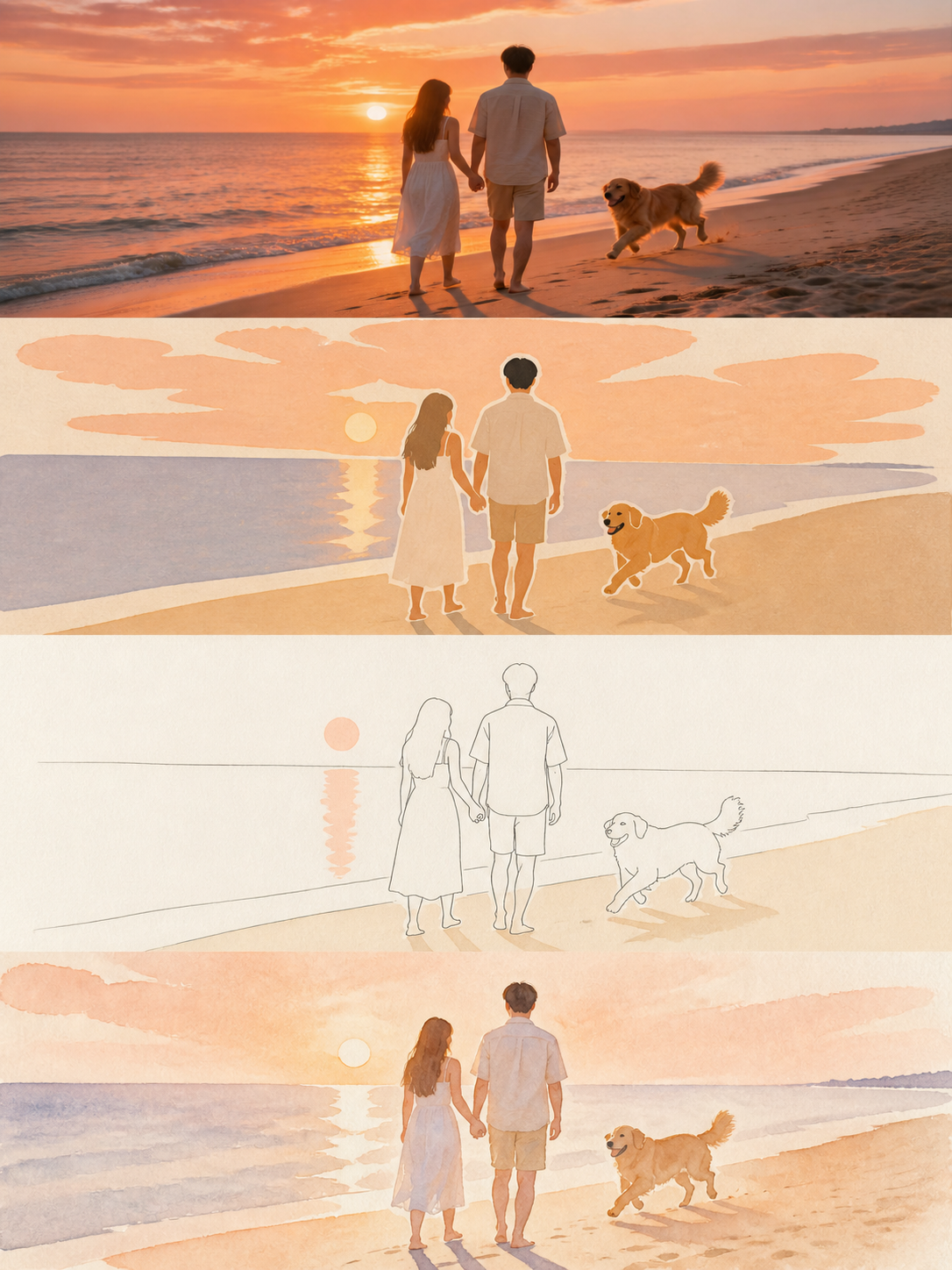
01
Sunset Walk
Seaside couple, golden retriever and sunset
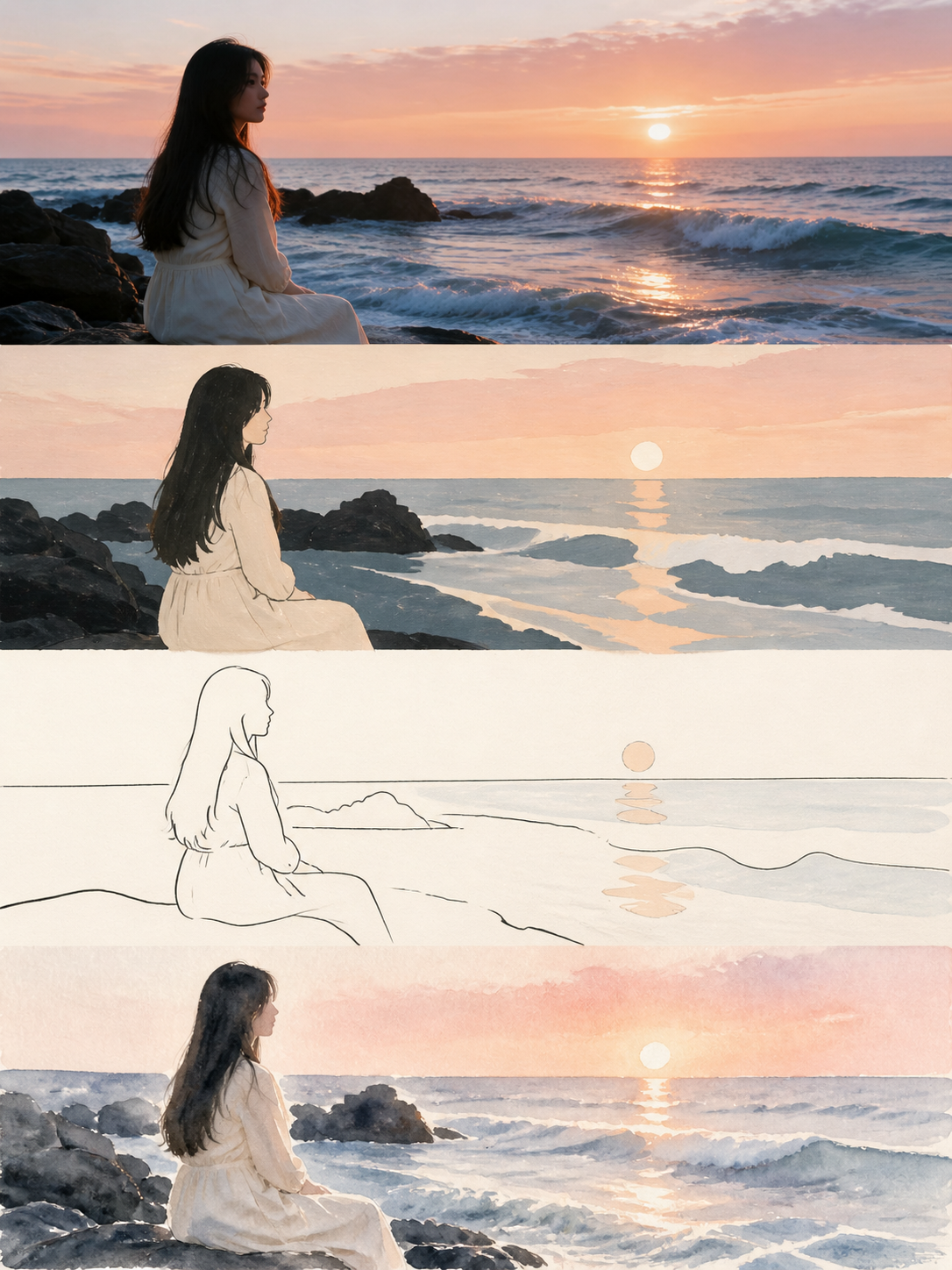
02
Listening to Dusk
Rocky shore, portrait and ocean sunset
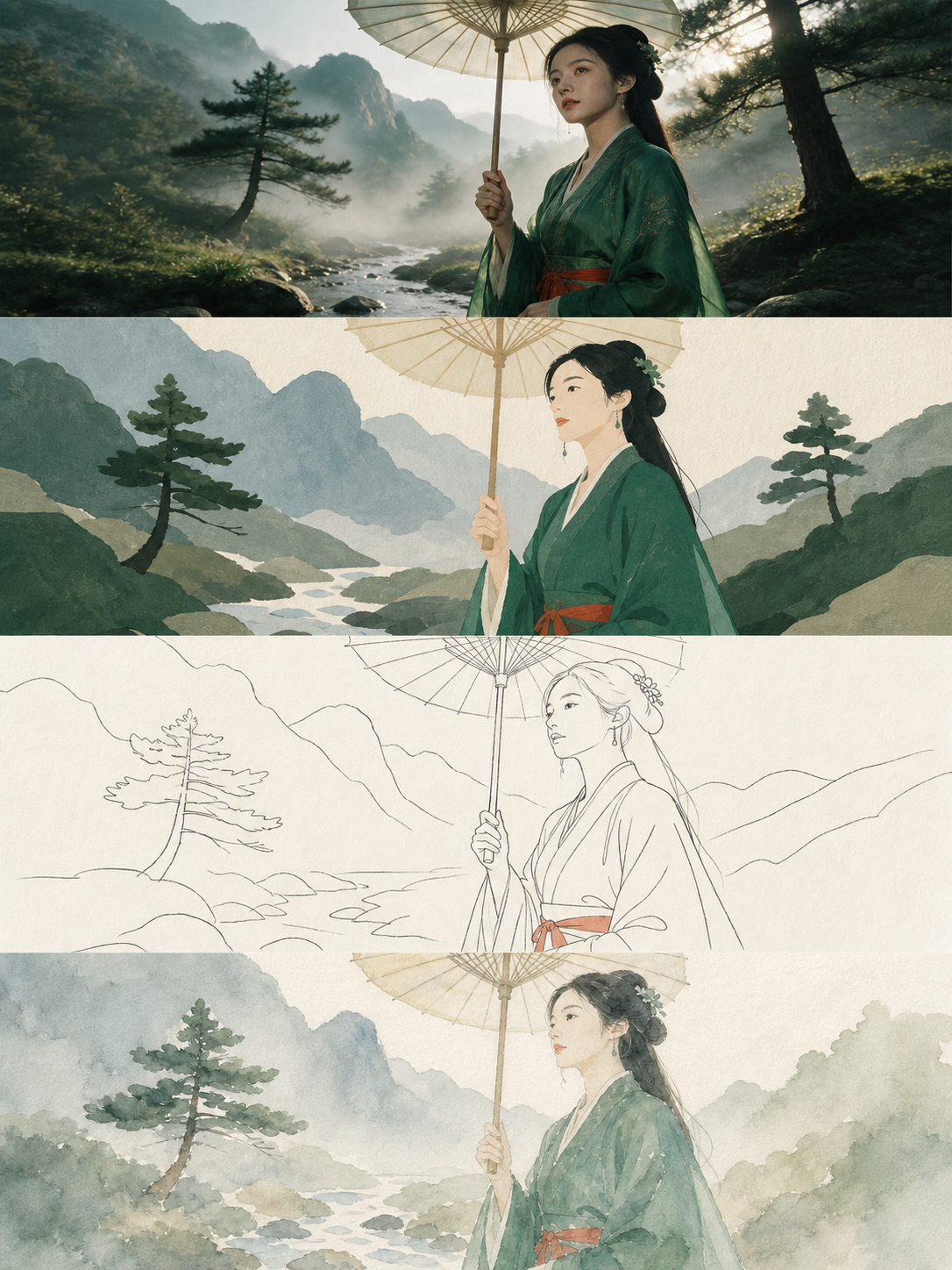
03
Mountain Umbrella
Traditional portrait, stream and distant peaks
Translate one photograph through three visual mediaLearn how to structure prompts →